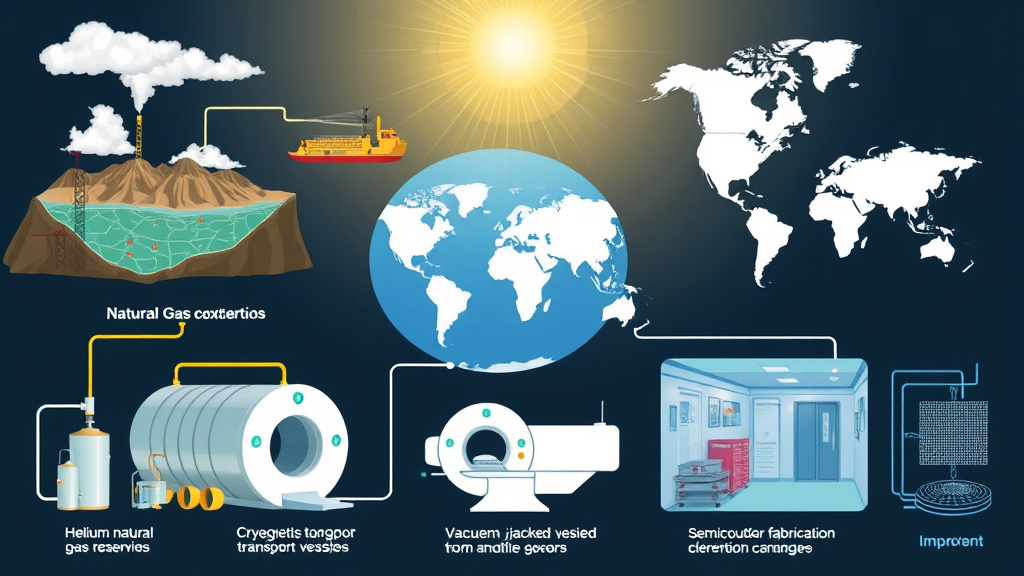
China has imposed a temporary and immediate ban on helium exports. The explainer says the timing, reasons, and scope were not initially made public. The development matters because helium is a critical industrial gas with limited substitutes and a fragile global supply chain.
The helium section places the ban in a wider supply context. Russia’s export restrictions have already added uncertainty, and regional tensions around West Asia have increased the risk to shipments passing near key routes. China is described as a small producer that depends heavily on imports.
Why helium is strategically important
Helium is generated deep underground through radioactive decay, accumulates in natural-gas reservoirs, and is commercially recovered only when concentrations are sufficient. The gas is separated using its distinct boiling point and is usually produced at very high purity.
Helium is difficult to substitute because it has an extremely low boiling point and is chemically inert. These properties make it important in magnetic resonance imaging, semiconductor fabrication, leak detection, aerospace systems, balloon and airship inflation, and some quantum-related applications.
The explainer notes that other sources, such as recovery from liquefied natural gas plants or from air, are minor compared with reservoir-based production. It also mentions that U.S. Geological Survey end-use categories include laboratory use, controlled atmospheres and semiconductors, lifting gas, MRI scanners, aerospace, and leak detection.
Related current affairs
- Groundbreaking ceremony: Advanced System in Package (OSAT) facility by ASiP Technologies (in presence of PM Shri Narendra Modi)
- What goals does Semicon 2.0 aim to achieve? How is it different from the first phase? What incentives does the Mobile Phone Manufacturing Scheme offer?
- Govt not keen to cover land, tech transfer costs in new chips scheme
- Cabinet okays Semicon 2.0, mobile, urea manufacturing schemes, highways