Study finds efficient way to filter nuclear wastewater
A laboratory study reported a stainless-steel mesh coated with a chromium-based metal-organic framework that improved tritium separation from tritiated water.
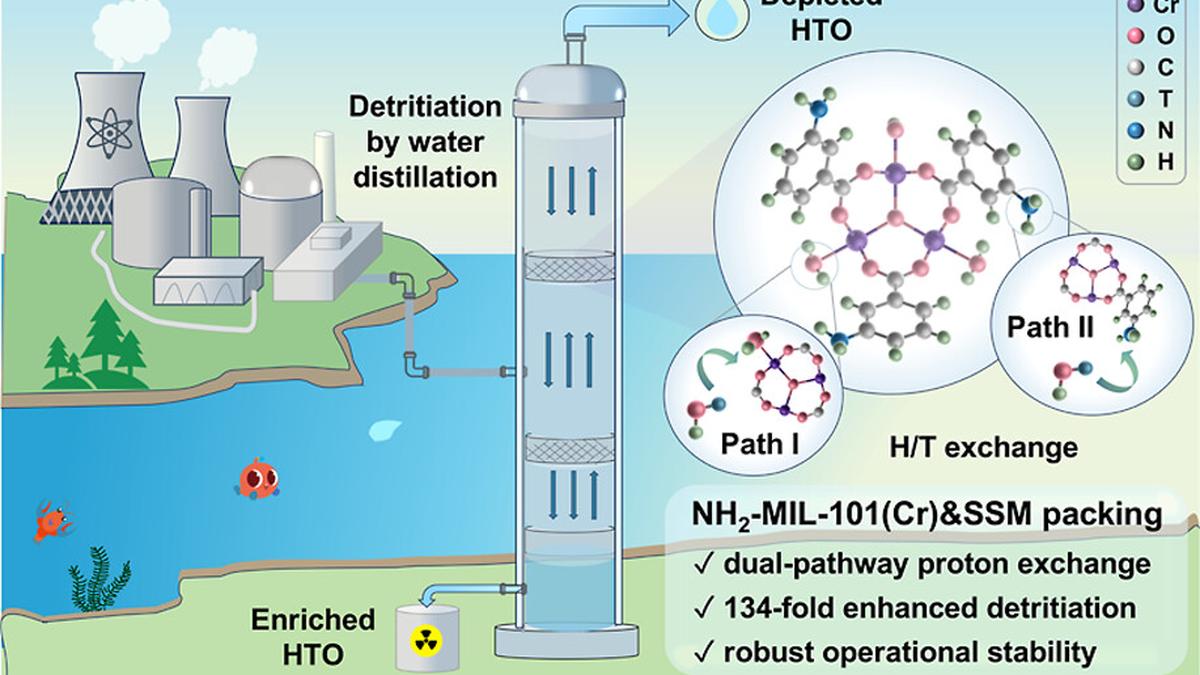
- Tritium is a radioactive isotope of hydrogen and is difficult to separate from water when present in tritiated water.
- Japan has been releasing treated water from the damaged Fukushima nuclear plant into the Pacific Ocean.
- Distillation is the practical method mentioned for separating tritium from water, but it requires very tall towers and high energy use.
- The study used a stainless-steel mesh coated with NH2-MIL-101(Cr), a chromium-based metal-organic framework, to improve separation efficiency.
A study in Environmental Science & Technology reported an improved method for removing tritium from tritiated water. The finding matters because tritium is hard to separate from water, and the research points to a potentially more efficient approach for nuclear wastewater treatment and isotope separation.
Japan has been releasing treated water from the damaged Fukushima nuclear plant into the Pacific Ocean, and the scientific challenge is that tritiated water behaves almost like ordinary water, making the contaminant difficult to remove at scale.
Background and earlier position
UPSC may ask about the scientific challenge of separating tritium from water, the role of metal-organic frameworks in separation technology, and the environmental significance of managing radioactive wastewater safely.