What happened
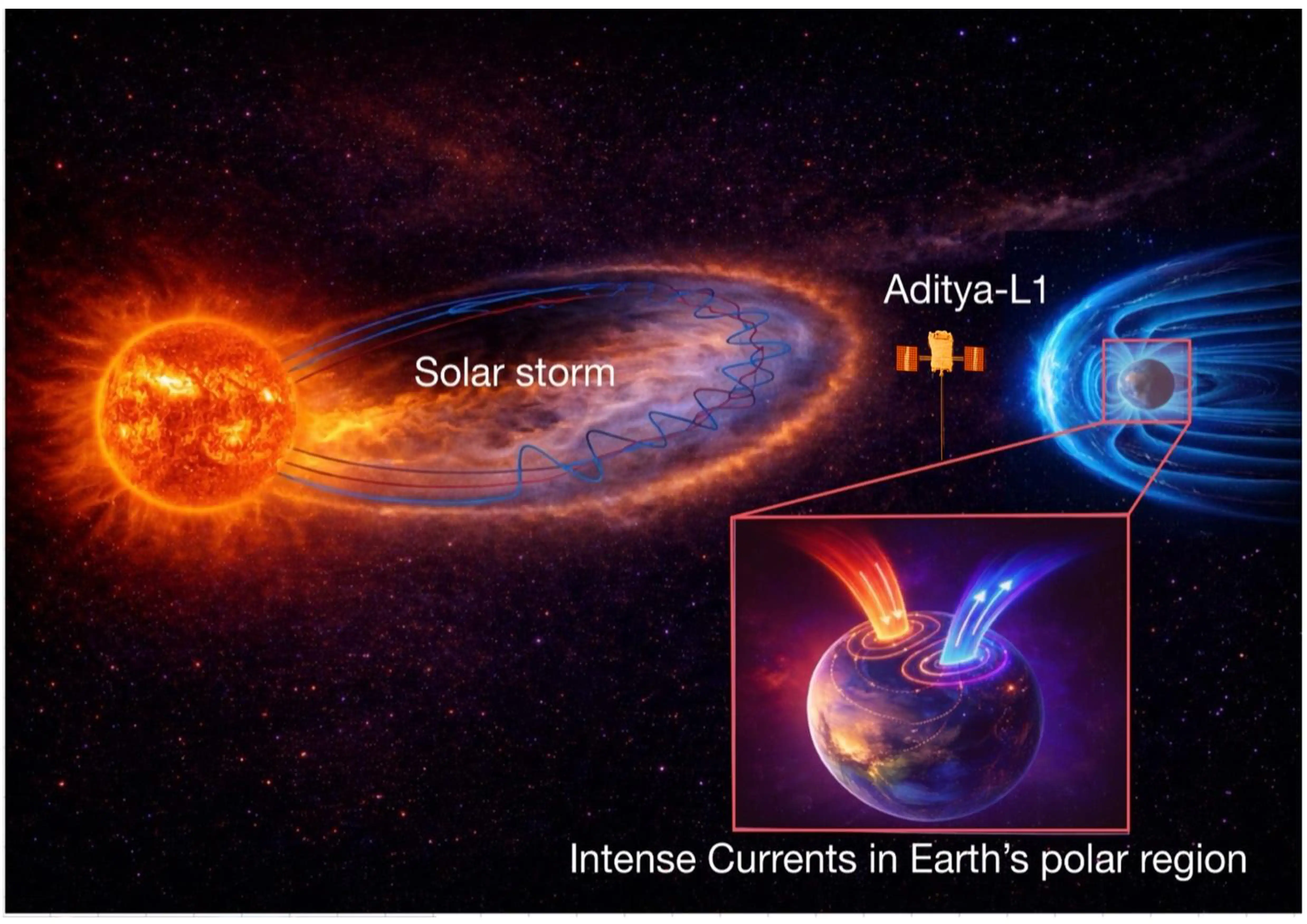
Indian astrophysicists have identified a new way to read the behaviour of Interplanetary Coronal Mass Ejections (ICMEs) as they travel from the Sun to near-Earth space. The study shows that the thermal state of these solar eruptions is not a minor detail: it is linked to how strongly they can disturb Earth’s magnetic environment and trigger geomagnetic storms.
The research was conducted by scientists from the Indian Institute of Astrophysics (IIA), Bengaluru, an autonomous institute under the Department of Science and Technology (DST). The study is presented as the first long-term statistical investigation of ICME thermal behaviour at 1 Astronomical Unit (AU), using observations spanning 1995 to 2024 across solar cycles 23, 24, and the rising phase of 25.
Background and earlier position
Earlier space weather studies have usually focused on ICME speed, magnetic structure, or individual storm events. The thermal evolution of ICME plasma during interplanetary travel has received less attention, even though heating or cooling during transit can influence the storm’s final impact when it reaches Earth.
ICMEs are massive eruptions of magnetised plasma from the Sun’s outer atmosphere. When they are directed towards Earth, they can interact with Earth’s magnetic field and produce geomagnetic storms that affect satellite operations, navigation signals, radio communications, aviation routes, and power grids.