What happened: the Supreme Court’s reasoning on interim relief vs tribunal enforcement
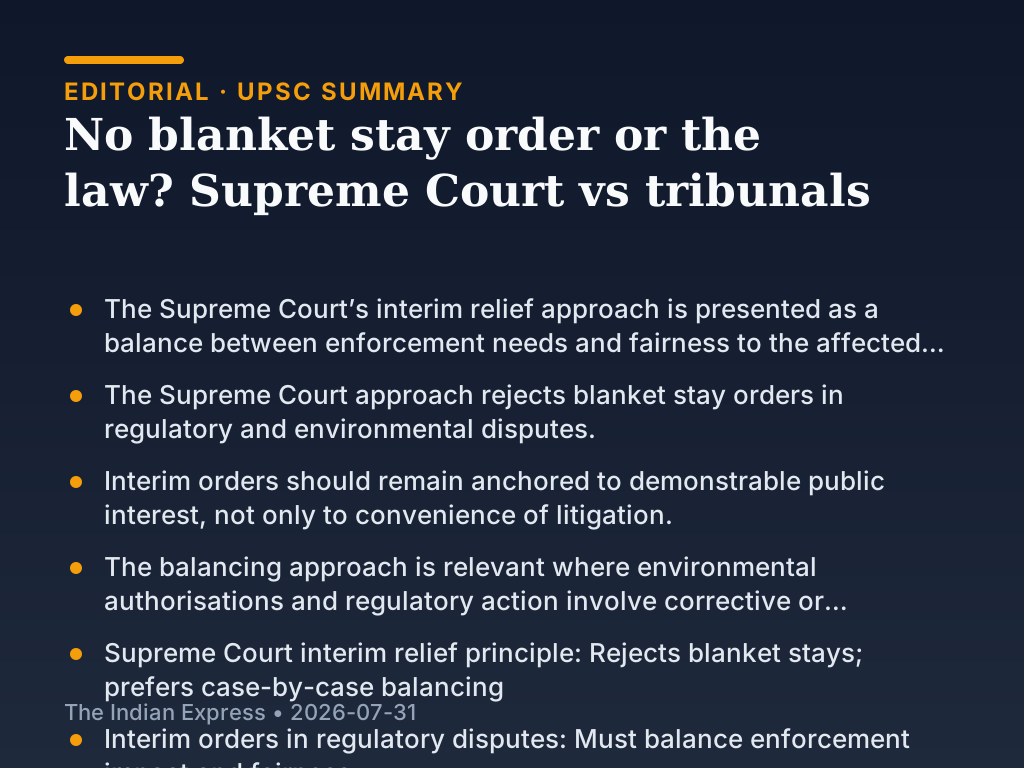
The Supreme Court’s approach to interim relief in environmental and regulatory matters is presented as a balancing exercise rather than an automatic rule. The Supreme Court’s emphasis is on avoiding blanket stay orders that pause enforcement in every case, because a blanket stay can create practical harm and can also shift the balance away from the public interest. Interim relief should be shaped by a careful test that looks at fairness to the affected party and the impact on enforcement and regulatory goals.
In regulatory settings like environmental authorisations and corrective approvals, court oversight matters because tribunals and administrative authorities take decisions that can affect compliance timelines, authorisation status, and public harm risk. The Supreme Court’s approach aims to ensure that any pause in implementation is justified on the facts and is anchored in reasons related to public interest, not only on litigation convenience.
Background and earlier position: why stays and interim orders are a recurring issue
Regulatory decisions often come through a chain: administrative or regulatory authorities first decide (for example, environmental authorisation or regulatory action), and then the decision may be challenged before a tribunal or through judicial review. During pending proceedings, parties frequently seek interim relief so that the benefits or burdens of the decision are held in abeyance. The legal challenge is that an interim stay can freeze compliance or enforcement, but the denial of interim relief can sometimes leave a party to suffer irreparable consequences if the final decision later turns out to be wrong.
The core governance tension can be understood as two competing needs: Enforcement stability: regulatory goals and public protection require decisions to operate unless there is a strong reason to pause them.Fairness to parties: if there is a credible challenge to legality or correctness, the affected person needs meaningful judicial protection rather than waiting for a final outcome that may come too late.
Related current affairs
- The judgment has sought to strike a middle path—…
- After a brief pause, U.S. and Iran resume strikes
- U.S. government pauses immigrant visa appointments for applicants worldwide
- SC notice to Jharkhand on plea on exam irregularities
- Stone quarries and crushers in the vicinity could put Assam’s semiconductor plant at risk
- SC bans constructions near Rajasthan’s Jojari river to curb pollution