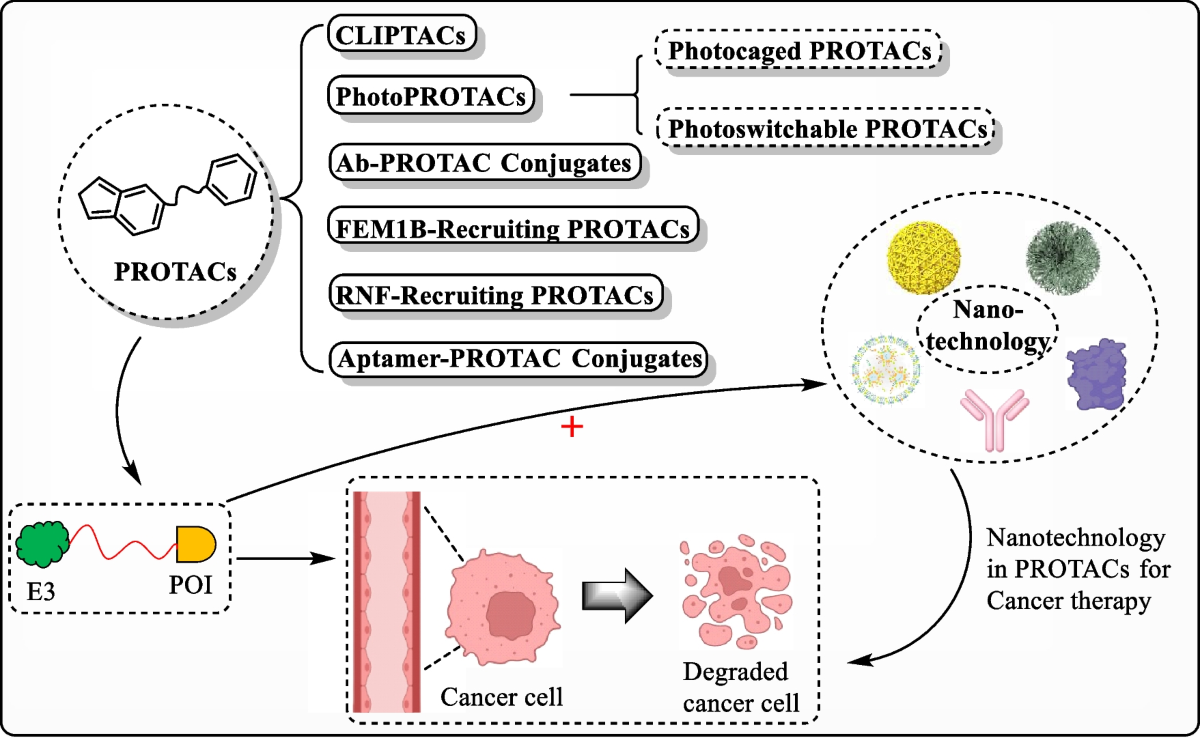
The U.S. Food and Drug Administration has approved vepdegestrant, a therapy for patients with ESR1-mutated, ER-positive, HER2-negative advanced breast cancer. The approval is notable because it is the first FDA-approved treatment that uses PROTAC (proteolysis-targeting chimaera) technology—an approach that eliminates a disease-causing protein inside cells rather than merely blocking it.
The article explains how PROTACs function. Each PROTAC molecule is built to connect two components: it binds to a chosen target protein and simultaneously recruits an E3 ligase, a cellular enzyme involved in protein breakdown. Bringing these together triggers targeted protein degradation. Unlike conventional inhibitors, which often need to remain bound to the protein for prolonged periods, PROTACs can act repeatedly: once they induce degradation of the target, they are released and can initiate degradation again.
The scientific pathway leading to clinical use of PROTACs is traced back to early 2000s demonstrations of targeted protein degradation, which saw significant advancements during the 2010s. The first PROTAC candidate to enter human trials was bavdegalutamide in 2019, followed by vepdegestrant for advanced breast cancer.
The phase 3 study for vepdegestrant involved 624 patients previously treated with CDK4/6 inhibitors and endocrine therapy. Among those with ESR1-mutated tumors, vepdegestrant controlled the disease for about five months, compared to 2.1 months with fulvestrant, the standard treatment.
Related current affairs
- Update on incentives disbursed under PLI Schemes for Pharmaceuticals, Bulk Drugs and Medical Devices
- Sun Pharma gets Brazilian regulator nod for Semaglutide
- District-wise number of Jan Aushadhi Kendras in Assam (as on 30.06.2026)
- Schemes to strengthen pharmaceutical and bulk drug manufacturing in Maharashtra
- Schemes to promote indigenous manufacturing of high-end and high-precision medical devices (PLI, Medical Device Parks, SMDI)
- Steps to reduce import dependence: PLI schemes for pharma/medical devices, urea self-sufficiency measures, and NBS policy actions for P&K fertilizers