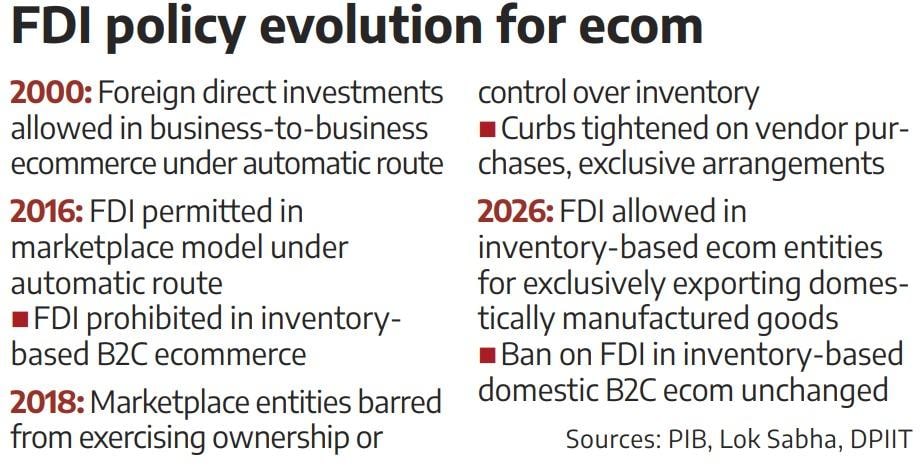
The Government of India has proposed a relaxation in foreign direct investment (FDI) rules for e-commerce companies that hold inventory. The proposed relaxation applies only when the inventory is used for exports and the goods are domestically manufactured and/or produced. The change matters because India has kept a cautious e-commerce FDI regime for years to protect small traders and to stay consistent with restrictions on multi-brand retail.
What existed earlier
India’s e-commerce FDI policy had generally permitted foreign investment in business-to-business (B2B) e-commerce and in marketplace models where the platform only connected buyers and sellers without holding its own inventory. The policy approach was designed to prevent foreign-funded platforms from functioning like inventory-led retailers in a sector where domestic small traders remain politically and economically sensitive.
What changed now
According to a commerce ministry statement, the existing FDI policy has been reviewed to remove restrictions on inventory-based e-commerce models when the exports involve domestically manufactured and/or produced goods and products. The proposal is narrow: it does not open inventory-led e-commerce for general domestic retail, but links the relaxation to export activity.
Why the change matters
Related current affairs
- India’s private space sector sees momentum; investment crosses USD 618.5 million and safety-security guidelines to be strengthened
- Export-oriented aquaculture support and sustainability measures under PMMSY (RAS/Biofloc, TED fitment, turtle-safe trawls)
- Net FDI negative in May on $74 million excess outflow
- India’s renewable energy installed capacity rises nearly fourfold to 288.58 GW since 2014
- PLI Schemes attract over ₹2.40 lakh crore investment and generate 14.15 lakh jobs; exports exceed ₹15.2 lakh crore
- RBI plans wider test for foreign control of firms