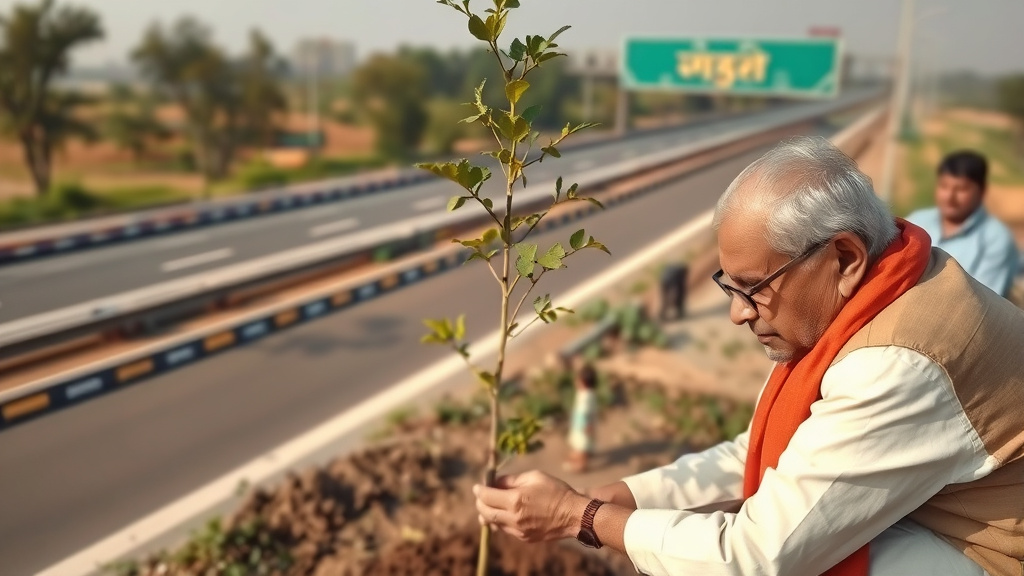
Uttar Pradesh has launched a large plantation campaign under the name ‘Ek Pedh Maa Ke Naam’. The state government said the campaign targeted 35 crore saplings, and the Chief Minister stated that 35.2 crore saplings were planted. The issue is relevant for UPSC because plantation targets are a common public-policy tool, but their environmental value depends on survival, maintenance, and monitoring.
What happened
Chief Minister Yogi Adityanath inaugurated the campaign in Gorakhpur and planted ‘Triveni’ saplings consisting of neem, peepal and banyan near the Bhagwanpur Toll Plaza on the Gorakhpur Link Expressway. He framed tree protection as essential for the welfare of humanity and for sustaining life.
Samajwadi Party chief Akhilesh Yadav criticised the campaign and alleged that the plantation programme was a corruption exercise rather than genuine environmental protection. He claimed the BJP's stated target implied at least ₹10 per sapling, which he calculated as about ₹350 crore, and said trees had been planted mainly on paper over the past decade.
Why the issue matters for UPSC
The plantation drive connects to the UPSC themes of environmental governance, sustainable development, and implementation gaps in public schemes. Plantation numbers alone do not establish ecological success; exam answers should distinguish between target achievement, survival rate, maintenance, and ground-level verification.
Related current affairs
- U.P. CM takes on SP in Etawah, Mainpuri; reaches out to youth
- People will wipe out SP in U.P. Assembly poll next year: CM
- Apex court clears UP’s night safari project in Kuka Rani Reserve Forest
- Ethanol is new name for ‘profiteering’, says Akhilesh
- In Telangana, it takes a village to save a beloved tree
- SP promises aid for all women; to reopen 26,000 schools shut in U.P. if party wins 2027 poll