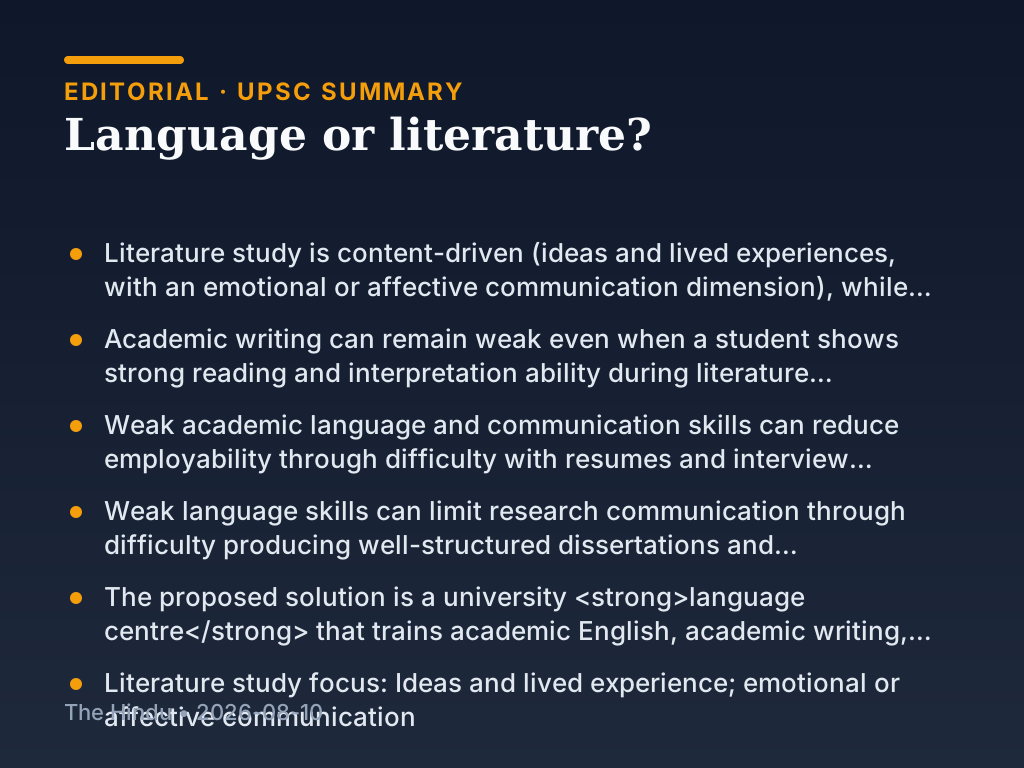
What happened: language skills are treated as a core academic need in higher education
An opinion piece highlights a misunderstanding: students are not automatically equipped to communicate academically just because they are studying English or literature. The author distinguishes literature study from language proficiency, and then argues that higher education needs structured training in academic English and academic writing for students across disciplines.
Background and earlier position: literature study and language proficiency are different
The opinion piece presents a content-versus-structure distinction: Literature study is content-driven. Literature study focuses on ideas and lived experiences and communicates through an emotional or affective dimension.Language study is structure-driven. Language study focuses on grammar, vocabulary, and syntax (the arrangement of words to form meaningful sentences) and on understanding underlying structure.It adds that literature students may be strong readers and interpreters but may still find it difficult to write essays that match the nuanced perspective they demonstrate while reading.
What changed now: proposal for language centres to address gaps across disciplines
The opinion piece argues that the “language gap” is not limited to literature students. Students and scholars in sciences and other disciplines may also struggle to communicate research ideas clearly. The opinion piece links weak language and communication to employability and academic participation problems: difficulty writing effective resumesdifficulty speaking confidently in interviewsdifficulty communicating in professional settingsdifficulty producing well-structured dissertationsdifficulty producing conference papers that are critically engagedreduced confidence over time and reduced willingness to participate in academic forums
Related current affairs
- A thesis in an extraordinary time, a promise to keep
- Vacant seats (letter to the editor)
- Research capital: ‘Taxing frivolous industries will not find success’ — Indian academia to face change
- Indian academia’s ‘research capital’ call: ‘Tāying (Taxis?) will suffice / Tang aviation?’ (headline partially legible)
- Vice President C. P. Radhakrishnan graces SASTRA Deemed University’s Ruby and Silver Jubilee valedictory celebrations; launches six new schemes
- Parliament Questions: Access to Higher Education under National Digital University Initiative