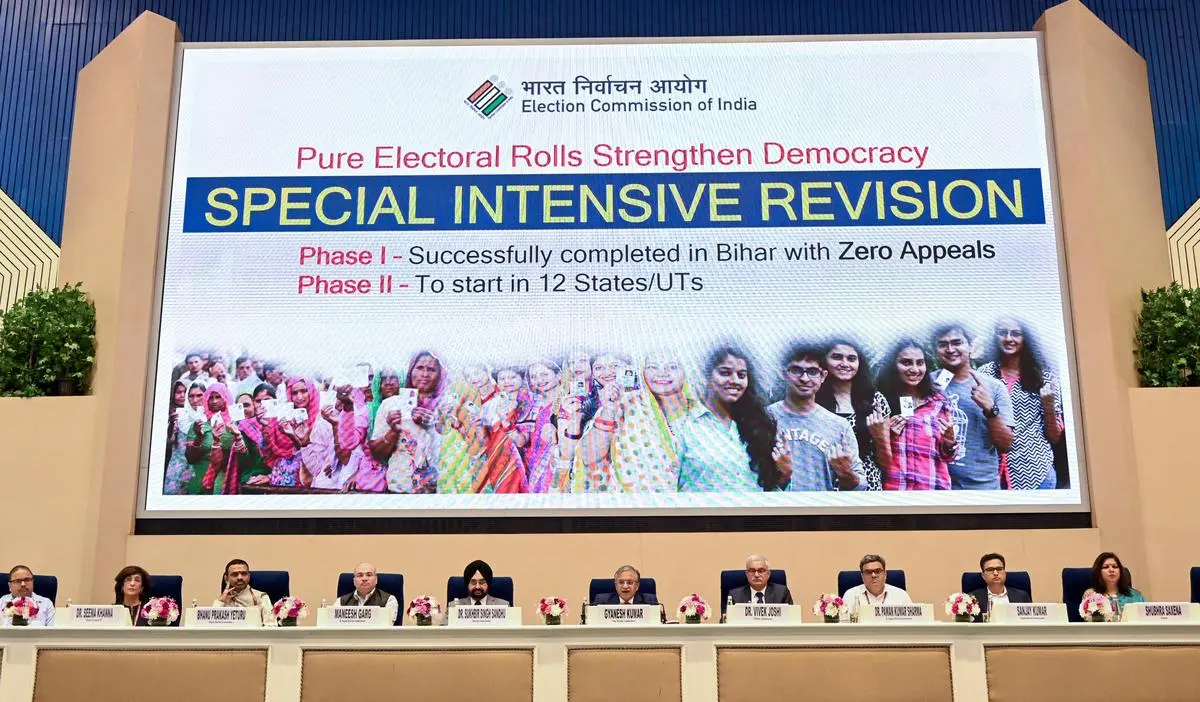
What happened: ECI’s phased Special Intensive Revision (SIR) of electoral rolls
The Election Commission of India (ECI) is conducting Special Intensive Revision (SIR) of electoral rolls in several phases across India to keep electoral rolls accurate, up to date, and free of ineligible or duplicate entries, while also ensuring that eligible electors are not left out. Phase I began in Bihar ahead of the 2025 State Legislative Assembly elections. Phase II covered nine States and three Union territories between October 2025 and April 2026. Phase III covers the remaining States and Union territories, including the National Capital Territory of Delhi, following an ECI-notified schedule that can be revised based on operational needs.
Background: How SIR is carried out and what gets deleted
SIR uses a house-to-house enumeration process by Booth Level Officers (BLOs) with enumeration forms, draft roll publication, a statutory claims-and-objections period using Forms 6, 7 and 8, and then a final roll after verification. ECI states that deletions during SIR are done only after due verification by BLOs through repeated house-to-house visits and broadly fall under four heads: death of the elector; permanent shifting of residence; duplicate entries of the same elector in more than one place; and electors found untraceable despite repeated visits.
Related current affairs
- Over 33 lakh electors left out in Haryana SIR phase 1
- The ECI must stop filing of bulk applications for deletion of voters
- Deletions in recent SIRs suggest arbitrary application of reasons (Telangana and Karnataka draft electoral rolls)
- Indian polls are conducted transparently, asserts CEC
- What did Trump say about India’s voting system? (FAQ)
- Faulty roll revision