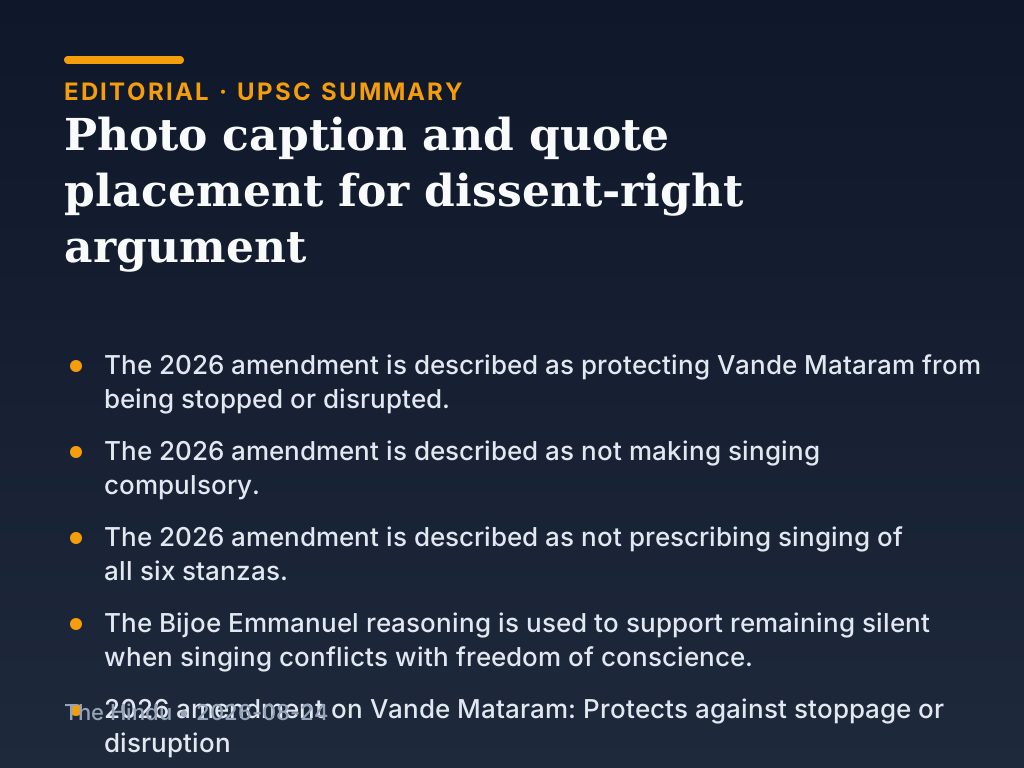
What happened (caption-level claims about the 2026 Vande Mataram amendment)
A caption/credit line under a main illustration states three related points about a 2026 amendment dealing with Vande Mataram in public settings:
Protection from disruption: the amendment is described as protecting Vande Mataram from being stopped or disrupted.No compulsory singing: the amendment is described as not making singing mandatory.No requirement to sing all six stanzas: the amendment is described as not prescribing singing of all six stanzas.
The caption/credit line adds a conscience-based justification using the Supreme Court’s Bijoe Emmanuel reasoning (the idea that individuals may remain silent when participation violates belief or conscience).
Background and earlier position (freedom of conscience and dissent rights)
Freedom of conscience is a core Constitutional principle (freedom to hold beliefs and to avoid forced participation against belief). In civic and educational settings, the Supreme Court’s Bijoe Emmanuel reasoning is used to support non-participation by silence when compulsory participation conflicts with religious or conscience-based principles.
Related current affairs
- Vande Mataram and the right to dissent
- THE GIST
- Letters to the Editor (Vande Mataram/Jana Gana Mana and anthem rendition principle)
- Pinarayi accuses UDF govt. of yielding to BJP, RSS on Waqf law
- Help operationalise women’s reservation: Smriti to Rahul
- BJP passes resolution against Cong. decision on Vande Mataram stanzas