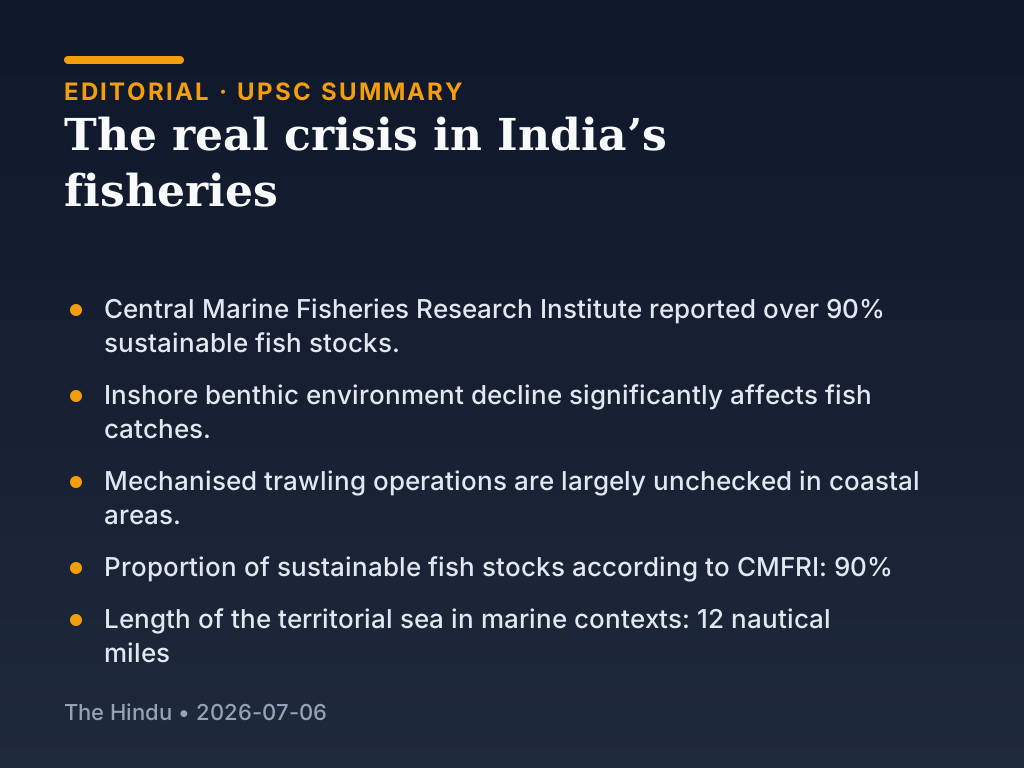
The piece questions official reassurance that India’s marine fish stocks are largely sustainable, arguing that the bigger problem is the continuing degradation of inshore fishing grounds and weak governance that fails to control mechanised trawling.
It notes that the government, citing figures from the Central Marine Fisheries Research Institute (CMFRI), claims that most evaluated fish stocks are in good health and that over 90% of assessed stocks were found sustainable (based on evaluations in 2022). The author, while not challenging CMFRI’s technical conclusions directly, raises serious doubts about whether 'sustainability' is being measured in a way that accurately reflects the condition of marine ecosystems.
A key concern is methodology: CMFRI’s approach is said to rely primarily on landing data—what fishermen catch and land—rather than direct in-sea stock assessments. The article argues that landing figures cannot reliably indicate the abundance of living resources offshore, since beach catches do not necessarily translate into stock availability in the sea.
In contrast, many other countries conduct at-sea stock assessments that better capture ecosystem health.
The author further contrasts the government’s optimism with the Food and Agriculture Organization’s (FAO) more cautious stance, which warns that many major stocks may already be fully exploited and that access and overcapacity have increased, particularly due to unregulated competition involving medium and small trawlers.
The narrative then shifts from 'overfishing' in the narrow sense to broader environmental decline. Drawing on long-term conversations with fishers along the Tamil Nadu coast, the author claims that catches have consistently fallen and previously available species are disappearing.
Related current affairs
- Vice President to launch Letter of Authorisation for Sustainable High Seas Fisheries and Odisha Deep Sea Fishing Mission Document
- World Biofuel Day (advertorial/feature)
- ICAR-CMFRI assessment: Marine fish stocks healthy; 91.1% evaluated stocks sustainable (2021-2025)
- Social security and aquaculture insurance support under PMMSY and PMMKSSY for fishers and shrimp farmers
- National digital traceability framework for fisheries and aquaculture (2025)
- Expansion plan for new multipurpose/dairy/fisheries cooperatives covering all Panchayats: Targets and Margdarshika/SOP