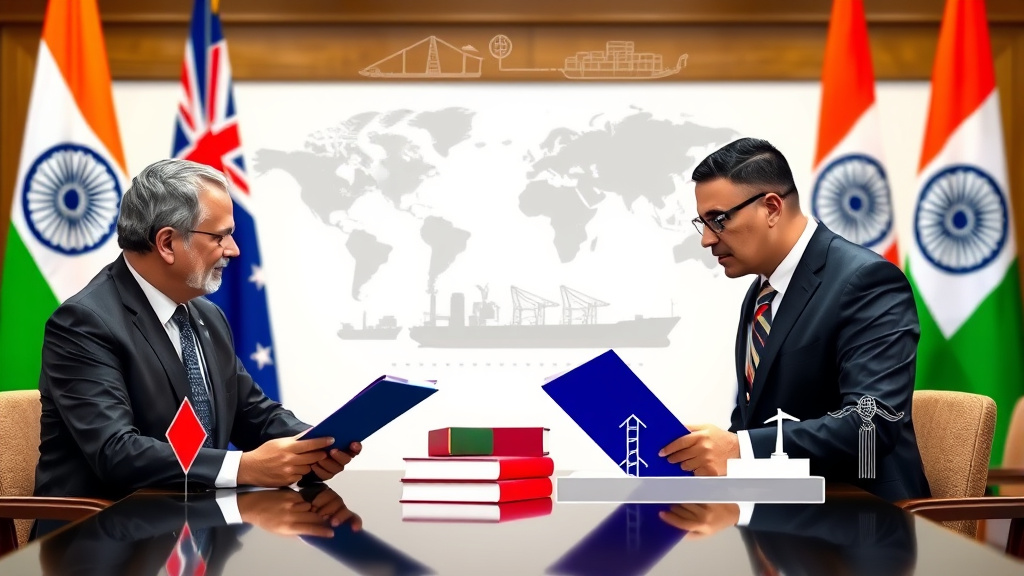
India and Australia have decided to deepen economic cooperation by moving quickly towards a Comprehensive Economic Cooperation Agreement (CECA) and a Bilateral Investment Treaty. This follows the expansion of trade and investment ties under the Economic Cooperation and Trade Agreement (ECTA), 2022. The development matters because it links market access, investment protection and the wider India–Australia Comprehensive Strategic Partnership.
The announcement was made during the Third Annual Summit in Melbourne on 2026-07-09. Prime Minister Albanese was acknowledged for his role in taking bilateral ties to a new level. The article does not give treaty text, timelines or sectoral concessions, so the exam value lies in understanding the direction of policy rather than the legal detail.
What changed now
Earlier, the relationship had already moved beyond diplomacy into a structured economic framework through the ECTA, 2022. Now both sides have decided to accelerate two deeper instruments: a broader CECA and a Bilateral Investment Treaty. The language of the announcement — “balanced”, “ambitious”, and “win-win” — suggests a search for deeper liberalisation without ignoring domestic sensitivities.
Background and continuity
India and Australia are often described as two vibrant democracies, two multicultural societies and two important ocean powers. These shared characteristics support cooperation in the Indo-Pacific, where trade security, sea-lane stability and supply-chain resilience have become central policy concerns. The current move continues the trend of upgrading bilateral ties from defence and strategic cooperation to more complex economic integration.
Related current affairs
- PM Modi participates in 3rd India-Australia Annual Summit; discusses CECA and deepens strategic partnership
- PM Modi meets Australian Governor-General Sam Mostyn
- India-Australia Joint Declaration on Defence and Security Cooperation
- Prime Minister’s Address (Economic Roadmap Business Reception): India–Australia economic partnership and sectoral cooperation
- Much more than ‘Melbourne meets Modi’: India–Australia partnership expands in security, business, education and culture
- Australian uranium fuels next phase in India’s n-programme