What happened: China’s AI progress is being driven by “open” deployment and scalable compute despite hardware limits
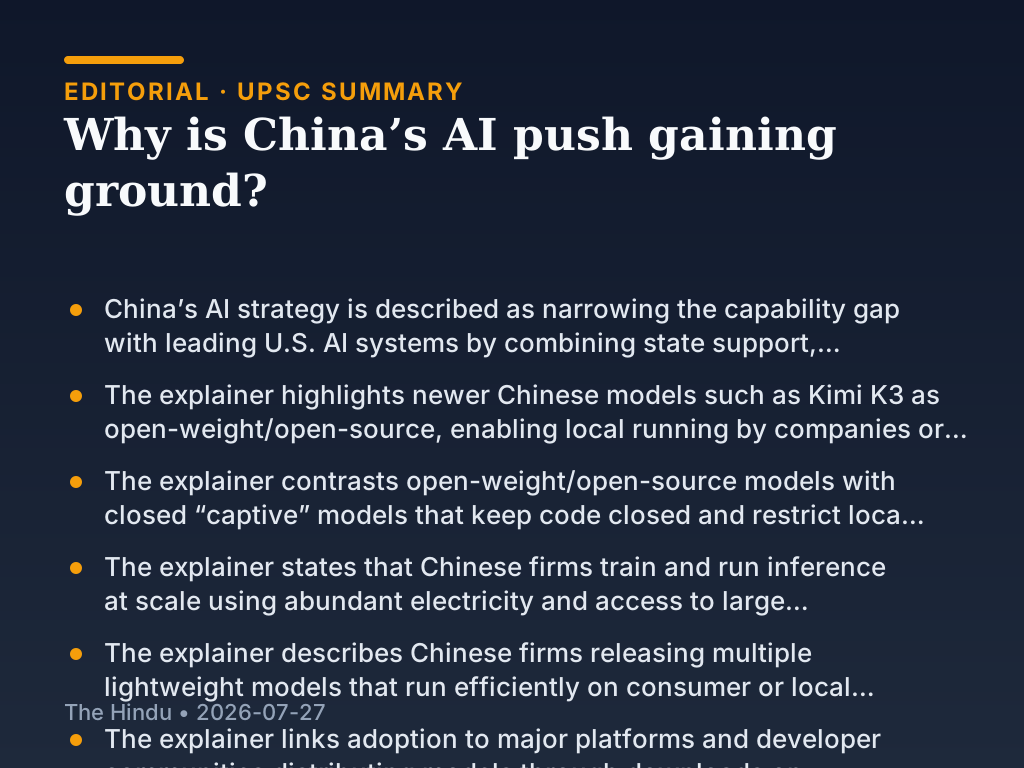
China’s AI push is gaining ground by narrowing the capability gap with leading U.S. AI systems. A core driver highlighted in the explainer is the pairing of government support and ecosystem building with large-scale use of available compute, even when access to high-end GPUs is restricted.
The explainer also points to the growing availability of Chinese AI models described as open-weight or open-source. Models such as Kimi K3 are described as usable by companies or individuals for local inference and deployment. In contrast, many “captive” AI models keep code and weights closed, which limits local running and can increase dependency on the vendor’s platform.
Beyond large general models, the explainer notes the release of lightweight Chinese models designed to run efficiently on consumer devices or local hardware. It adds that developer communities and major platforms have supported adoption by making downloads available on repositories.
Background and earlier position: China’s constraints were hardware limits and ecosystem dominance by U.S.-led platforms
A key background factor is hardware constraints faced by Chinese firms. The explainer describes restrictions on access to high-end GPUs, which would ordinarily slow training and limit scaling.
Related current affairs
- Is China’s AI bet turning U.S. AI labs into new Apple?
- Behind China’s AI gift, a constraint
- AI companies have long relied on online content. Now, though, it may be turning to books.
- Government sets up Centres of Excellence in AI for domains like agriculture, healthcare, sustainable cities and education
- The Irony of OpenAI’s ‘scam’ narrative
- BRICS Science Academies Forum Meeting 2026 concludes at IIT Hyderabad; focus on AI for sustainability and Global South cooperation