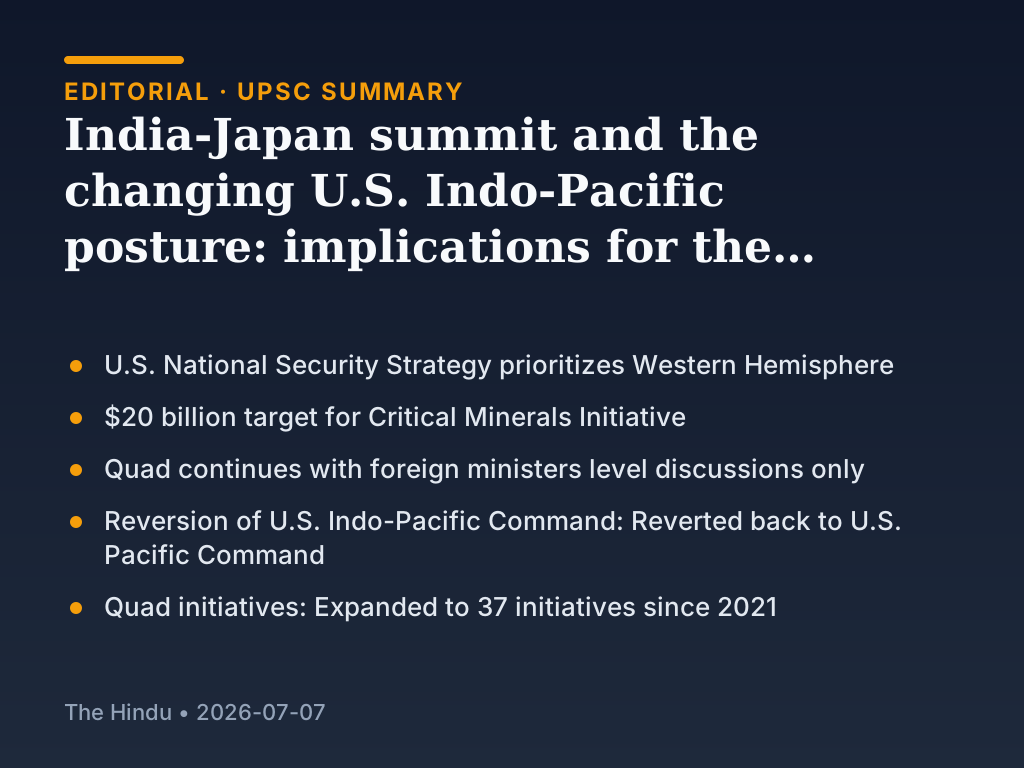
The article evaluates doubts about the Quad’s future by linking Japan’s prime minister’s visit to India for the 16th India–Japan Annual Summit with recent changes in U.S. strategic emphasis in the Indo-Pacific. It notes that the two sides reaffirmed commitment to a free and open Indo-Pacific, but suggests that the idea may be losing momentum in Washington.
A key trigger highlighted is the Pentagon’s decision to revert the U.S. Indo-Pacific Command back to the broader U.S. Pacific Command, reversing a 2018 renaming. The author argues that even though the 2018 change was symbolic, it acknowledged the Indo-Pacific’s rising strategic importance and India’s centrality. The reversal indicates the region has less priority than before.
It also points to the U.S. National Security Strategy released in November 2025, which is described as prioritizing the Western Hemisphere and mentioning the Quad only in passing. This shift appears meant to reduce friction with Beijing, which has long objected to the Indo-Pacific framing.
The article assesses criticisms of the Quad’s relevance. One criticism is that the Quad’s messaging hesitates to explicitly name China, even though the group is widely understood as balancing China’s military and economic assertiveness.
Another criticism discussed is that the Quad does not clearly position itself as a securitisation-oriented grouping. The effort to distinguish it from the Quadrilateral Security Dialogue (QSD) is noted, as the Quad avoids fully conflating branding and institutional identity.
Related current affairs
- Unimpeded trade needs IPMDA as the answer
- NATO enters a new strategic era of transformation — NATO’s European shift offers India new strategic and defence opportunities
- Rajnath: Great Nicobar project will safeguard Indo-Pacific interests
- With eye on China, Quad commits to strengthen 'free & open Indo-Pacific'
- 'Stable India-China ties will help build multi-polar Asia'
- Jaishankar to meet Quad counterparts in Manila on sidelines of ASEAN meet