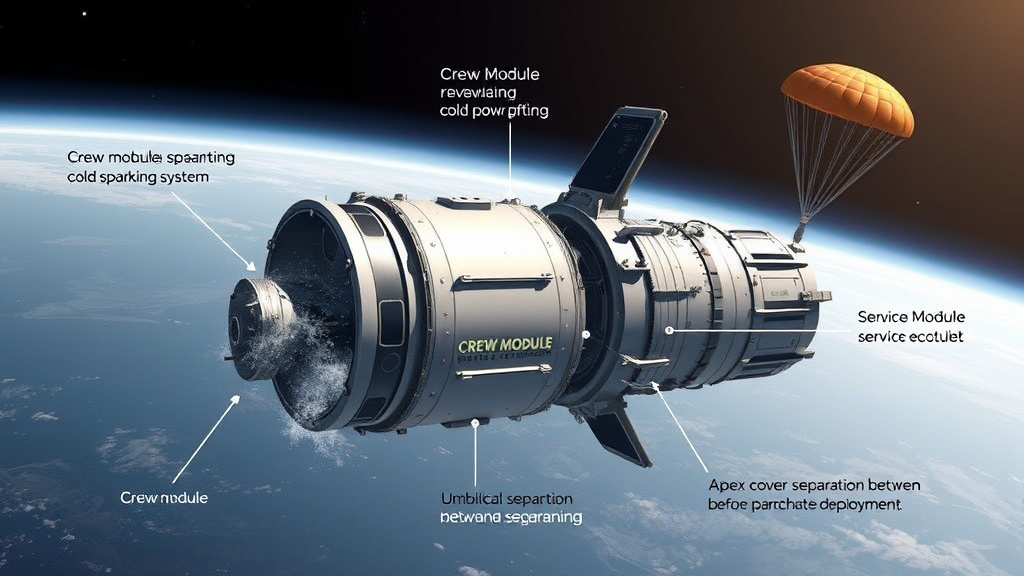
ISRO reported three major system-level tests for the Gaganyaan crew module. The tests covered uprighting after splashdown, crew module-service module separation, and apex cover separation before parachute deployment. These are safety-critical functions in India’s human spaceflight programme.
What happened
The first test verified the crew module’s upright positioning after sea splashdown using a stored cold-gas-based uprighting system. ISRO said it realised a system qualification test setup and completed inflation tests for the primary inflation module by pressurising gas through control valves.
The second test assessed the separation performance of the umbilical mechanism linking the crew module, described as the living or astronaut area, with the service module, which provides power and propulsion. The mechanism has two parts: CSU-1 on the crew module side and CSU-2 on the service module side.
ISRO said separation of CSU-2 from a simulated crew module was carried out, demonstrating clean separation and structural stability of the crew module panel interfaces.
The third test validated structural integrity during apex cover separation. The apex cover protects parachutes and related subsystems and is separated before parachute deployment.
Related current affairs
- How will Gaganyaan’s thermal shield protect the crew?
- Lok Sabha written reply: Progress on Gaganyaan mission and Bharatiya Antariksh Station roadmap
- NASA astronaut Annil Menon embarks on 8-month international mission to Space Station
- THE GIST (for Gaganyaan thermal shield)
- Zhurong 2 and China’s pace (feature/explainer)
- NASA astronauts Anil Menon, Jessica Meir undertake spacewalk outside ISS