What happened: Gaganyaan crew-module re-entry and TPS choice
India’s human spaceflight programme Gaganyaan is preparing a crew module to survive atmospheric re-entry—when the capsule travels back through Earth’s air at extremely high speed and experiences intense heating. A space-technology explainer focuses on the crew module’s re-entry phase and explains why thermal protection engineering becomes the deciding factor for crew safety once descent begins.
The explainer states these key re-entry and design constraints for the crew module:
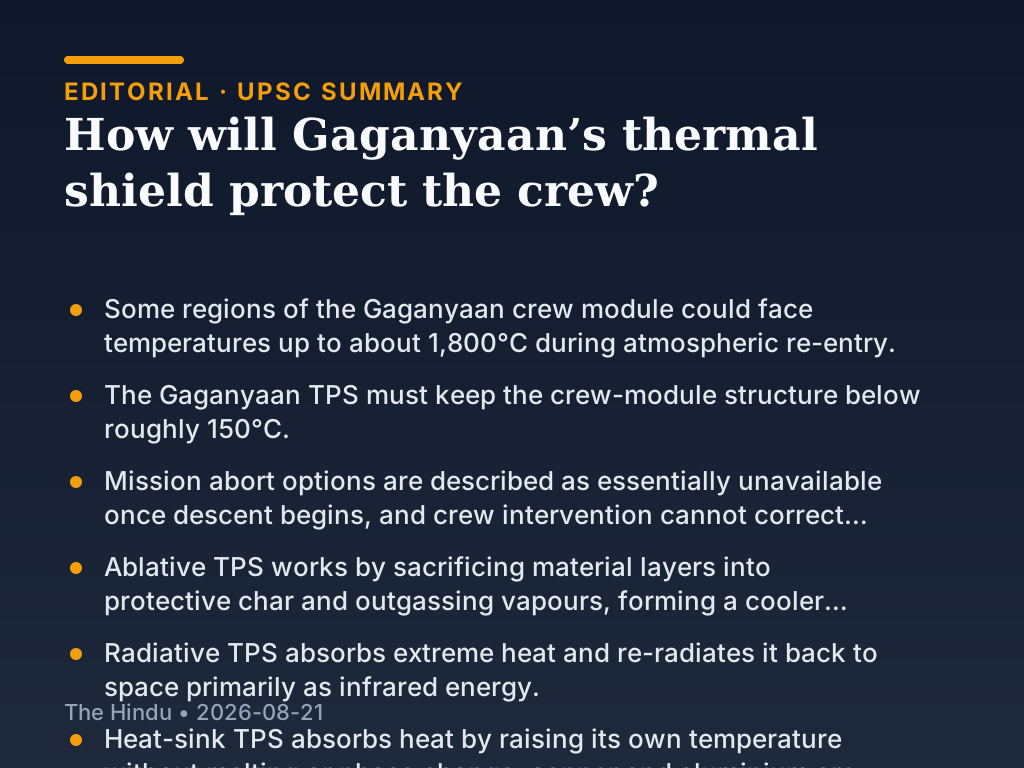
Maximum re-entry heating occurs because re-entry converts most kinetic energy into atmospheric heat; only a smaller share of heat that reaches the module still remains intense.Some regions of the Gaganyaan crew module could face temperatures up to about 1,800°C.The thermal protection system (TPS) must keep the crew-module structure below roughly 150°C.Once descent begins, mission abort options are described as essentially unavailable; crew intervention cannot correct rapidly changing non-conformance because response times are very short.
On the basis of these constraints, the explainer says Gaganyaan uses an ablative thermal protection system—a design approach chosen for proven performance and suitability for a single-use mission philosophy.
Background and earlier position: why rockets and spacecraft face a re-entry “inferno”
Related current affairs
- Explainer THE GIST: Gaganyaan thermal protection system
- THE GIST (for Gaganyaan thermal shield)
- Lok Sabha written reply: Progress on Gaganyaan human spaceflight mission and Bharatiya Antariksh Station timeline
- How the Gaganyaan crew module is built to survive
- Opposition raises concerns over ‘weakening’ of ISRO; Centre hits back
- Lok Sabha written reply: Progress on Gaganyaan mission and Bharatiya Antariksh Station roadmap