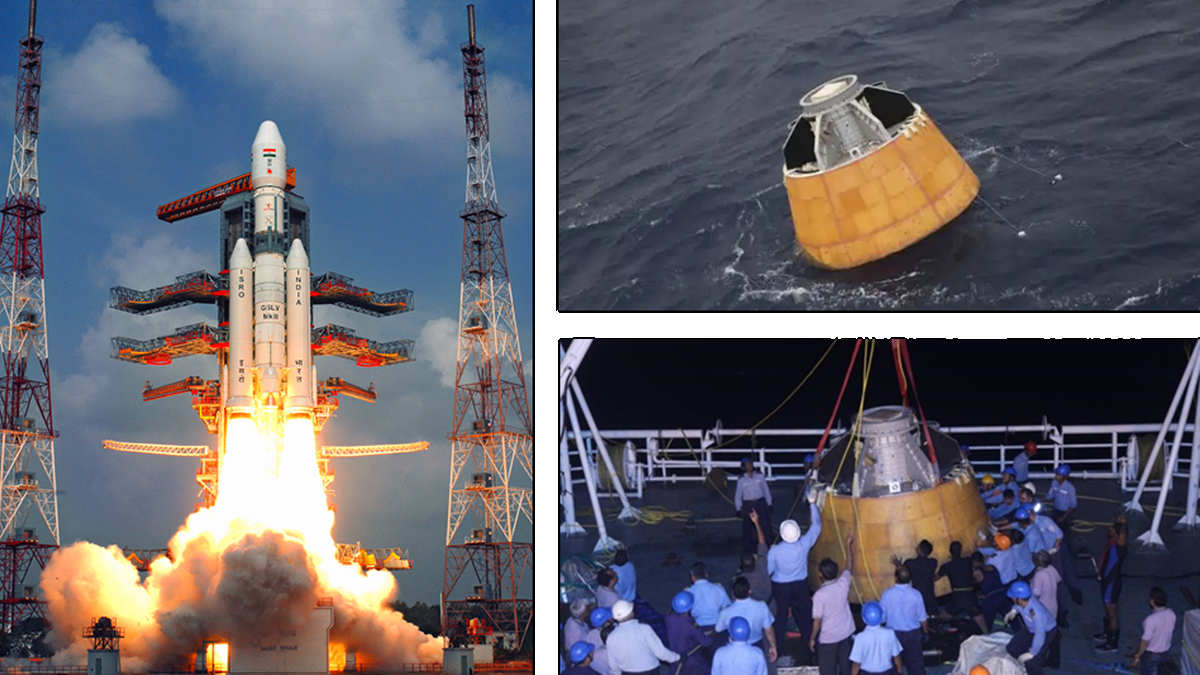
What happened
The Press Information Bureau has published an explainer on Gaganyaan, India’s human spaceflight mission. The note says the mission is built around the Human-rated Launch Vehicle Mark-3, which will place the orbital module into space carrying Indian astronauts.
The orbital module has a crew module and a service module joined together during flight. The service module supports the spacecraft in orbit and later fires its thrusters to de-orbit the vehicle before separation. The crew module is intended to survive re-entry and splash down safely, while the service module burns up.
Engineering logic behind the design
The explainer says no single shape can maximise all design goals at once. Engineers must balance internal volume, structural mass, aerodynamic lift and drag, manufacturability, stability, and low-speed behaviour.
It notes that a spherical shape gives maximum volume for minimum mass, but it creates no lift and can produce harsh g-forces. For that reason, the crew module uses a sphere-cone configuration.
Related current affairs
- How will Gaganyaan’s thermal shield protect the crew?
- Opposition raises concerns over ‘weakening’ of ISRO; Centre hits back
- THE GIST (for Gaganyaan thermal shield)
- Explainer THE GIST: Gaganyaan thermal protection system
- Lok Sabha written reply: Progress on Gaganyaan human spaceflight mission and Bharatiya Antariksh Station timeline
- ISRO & Japanese scientists review mission Chandrayaan-5 preparation