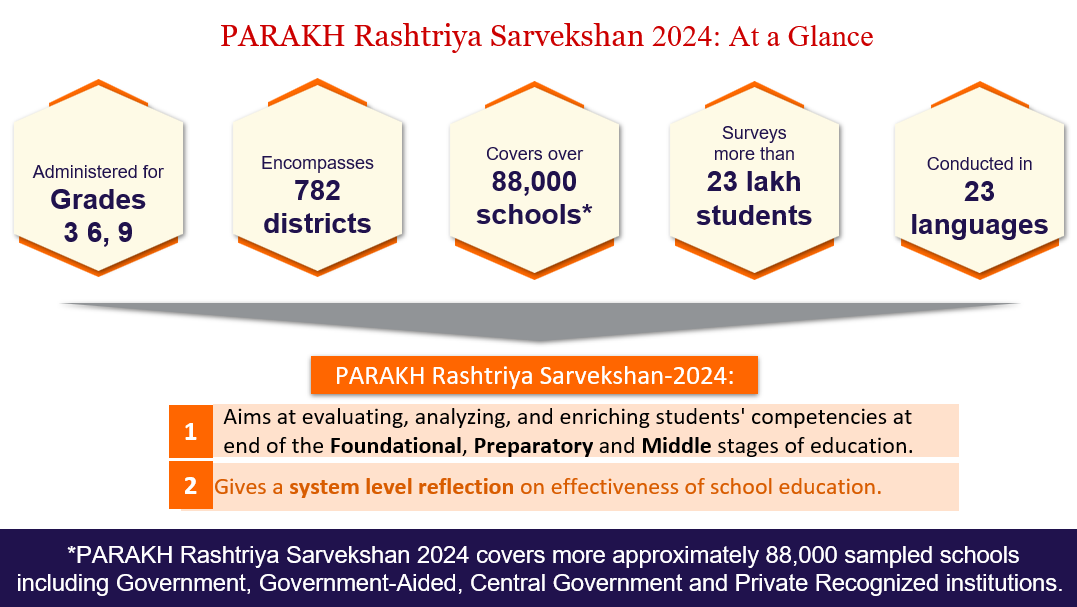
What happened: PARAKH Rashtriya Sarvekshan 2024 captured baseline learning under NEP 2020
The Ministry of Education used the National Assessment Centre, PARAKH (Performance Assessment, Review and Analysis of Knowledge for Holistic Development) to run PARAKH Rashtriya Sarvekshan (PRS) 2024, a baseline learning assessment under NEP 2020. The Ministry’s stated aim was to measure how far student competencies have developed by the end of key schooling stages, using large-scale assessment evidence and district-level reporting.
PRS 2024 was conducted in December 2024 for grades 3, 6, and 9 (end of Foundational, Preparatory, and Middle stages of education).
The government stated that PRS 2024 involved:
• 21.15 lakh students
• 2.70 lakh teachers and school leaders
Related current affairs
- Education Minister marks NCERT’s 66th Foundation Day; highlights NEP 2020, curriculum frameworks and multilingual textbooks
- Ensuring equity amid India’s educational progress
- UDISE+ Report 2025–26: India’s school education progress on access, equity, learning continuity and infrastructure
- Proposed PACER scheme budget for polar and ocean research: ₹270 crore for 2026–27
- Parliament Questions: Access to Higher Education under National Digital University Initiative
- Parliament question: UGC funding and higher education schemes (2021-22 to 2025-26)